
UK-built POCT middleware

Analyser results into the patient record, without retyping.

Catenix connects your point-of-care analysers to the clinical system your team already uses, whether that is EMIS Web, SystmOne, a LIMS or an EPR, and files each result against the right patient. Quality control, operator competency and the audit trail build as you work, so the evidence exists before anyone asks for it.

For POCT coordinators, quality managers, clinic teams and the IT people who support them. One site or a whole network: hospital, community, private clinic, mobile or remote.

45+ analyser connection guides Westgard QC with lockouts ISO 15189:2022 checklists built in Cyber Essentials certified No per-test fees
portal.catenix.com
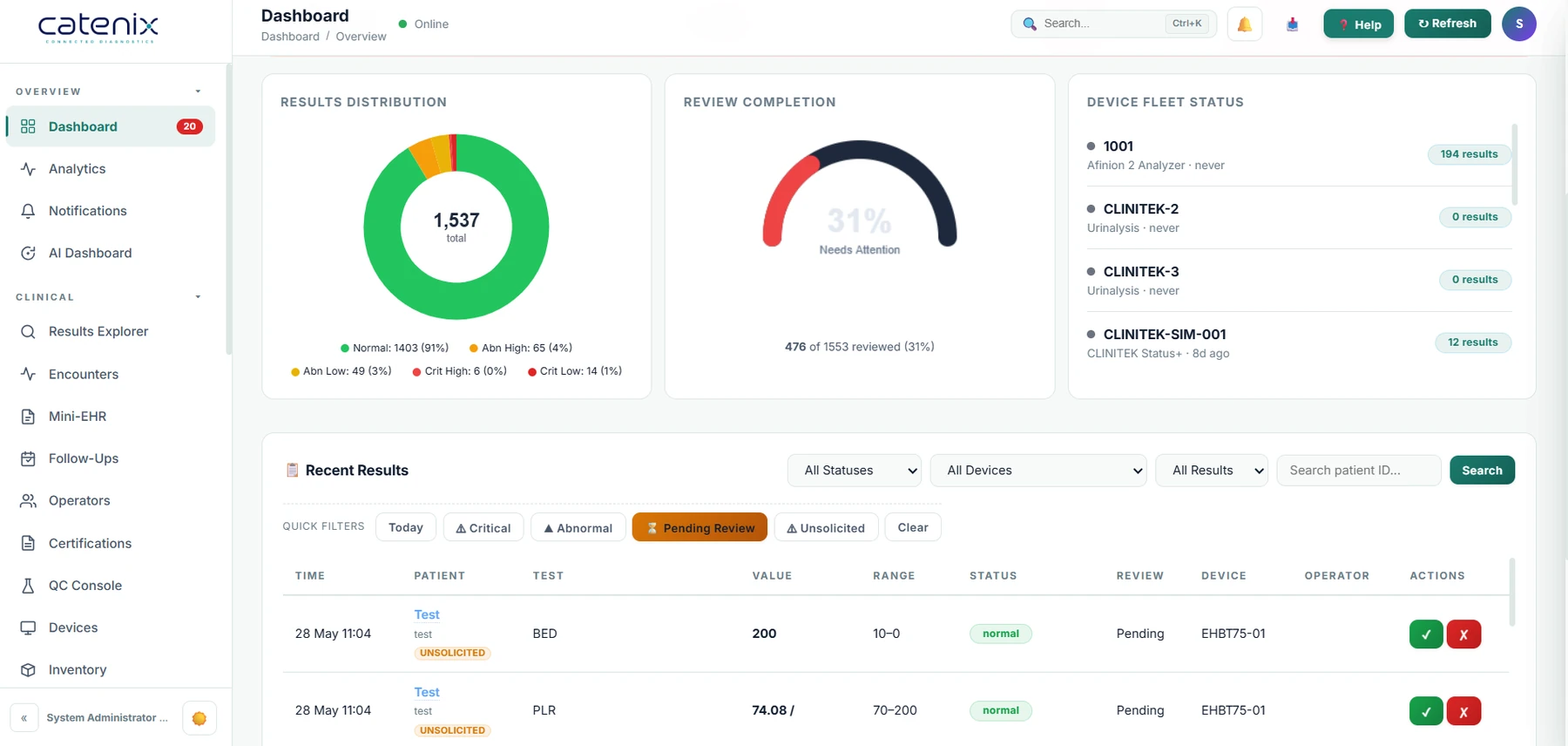
Catenix dashboard: results distribution, review completion, device fleet status and recent results

How it works

From analyser to the patient record, automatically.

Catenix reads your device over its own protocol, normalises the result and delivers it to the patient record in seconds. No re-typing, no USB sticks, no waiting.

Time saved 0 min and counting

Where it breaks

Most testing services lose time in the same five places.

Pick the one that sounds like yours. The path shows where the flow breaks, what Catenix does about it, and where to read more.

> trace patient → invoice 6 nodes break at patient → analyseranalyser → recordrecord → qualityquality → reportreport → invoice

  1. Patient01
  2. Analyser02
  3. Record03
  4. Quality04
  5. Report05
  6. Invoice06

Results land on the wrong patient

Someone reads an ID off one screen and types it into the analyser. One transposed digit and the result belongs to somebody else, which you may only find out later.

What Catenix does. The worklist goes out to the analyser with the patient already attached, and the result comes back matched to that same record. Nobody types an ID twice.

Bidirectional connectivity, not just result capture
We type results in by hand

Results sit on the analyser, in vendor software, in a binder or on a USB stick. Someone re-keys them into the record, then the report, then the invoice. Every copy is a chance to get it wrong.

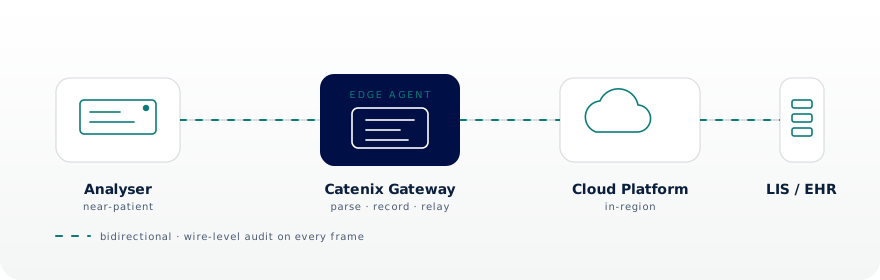
What Catenix does. A small on-site gateway reads the analyser directly, so the result is in the patient record seconds after the run finishes, with quality control kept separate from patient results automatically.

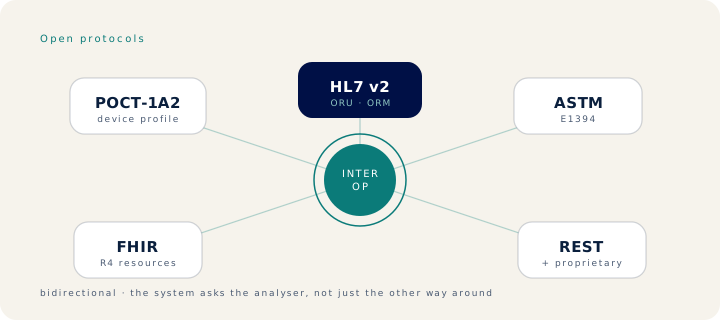
HL7, POCT1-A2 and ASTM, plus REST

QC and competency live in spreadsheets

Charts get drawn after the fact, competency sits in a folder, and audit week means reconstructing evidence you already had. The work was done properly. Proving it is the expensive part.

What Catenix does. QC runs are captured as they happen, Westgard rules flag the failures, and competency is recorded against the person who ran the test, so the evidence assembles itself as you work.

Levey-Jennings and a tamper-evident audit trail

Results take too long to reach the patient

A result produced in minutes takes days to reach the person it belongs to, because someone has to assemble the report, check it and send it on.

What Catenix does. Branded reports build from the same record the test landed in and go out by the route each patient or corporate client expects, once a clinician has authorised them.

Report and deliver from one record

Billing does not match what we did

Tests get run and never billed, or billed twice, because the invoice is built from a different list than the work. Reconciling the two is somebody's whole afternoon.

What Catenix does. Invoices are raised from the same encounter as the test, so what you bill is what you actually ran, whether the payer is the patient, an insurer or a corporate account.

One record from registration to invoice

None of these quite it? See every module or book a 30-minute walkthrough.

Works with your stack

Connects to the systems you already run.

Your analysers on one side, your record system on the other. Catenix sits in between and speaks to both.

UK and US clinical systems, GP systems, LIMS and EPRs, plus 46 analyser connection guides over HL7, POCT1-A2, ASTM and FHIR. See all integrations →

What Catenix does

Sixteen capabilities. One record. Pick where it hurts.

Everything below reads from and writes to the same record, so the evidence for an inspection is a by-product of running the service, not a project before the visit.

Connectivity & gateway

Every analyser reads into one record through a small on-site gateway, with the worklist going out to the device. Standards in, standards out.

Connectivity →

Results governance

No silent overwrites: reassign with a reason, audit on both patients, downstream corrections, critical results acknowledged before release, amendments that keep the original.

Results governance →

Quality control

QC captured from the analyser, Westgard rules and Levey-Jennings per device and analyte, lockouts, material expiry, failure reviews and the monthly sign-off.

Quality control →

Statistics Workbench Add-on

Verify a new analyser with EP15 and EP09 style studies, linearity, detection limits, reference intervals, measurement uncertainty and sigma, in a signed pack.

Workbench →

Quality management Add-on

Non-conformances, incidents, CAPA, ISO 15189:2022 audit checklists, a 5x5 risk register, field safety notices and a management-review pack that fills itself.

Quality management →

Device operations

Service, cleaning, downtime, custody, temperature excursions, firmware and opened reagents per device, with overdue items escalating on their own.

Device operations →

Operators & competency

Individual identity at the device, certification per operator per method with expiry, reminders before it lapses, competency in the management review.

Operators →

EQA Add-on

Deadlines with staged reminders and a calendar file, structured investigations of failed returns, z-score trends and an annual summary.

EQA →

Lot traceability

Which lots were on which analyser when each result was produced, recall impact lists you can export, and cost per test.

Traceability →

Notifications & Action Centre

Rules decide who hears about what; one acknowledgement stops the chain; escalation climbs when nobody answers; the Action Centre lists today's work.

Notifications →

Dashboards & Analytics Studio

Arrange your own dashboard from 46 widgets with presets for each role, and ask the questions standard reports miss.

Dashboards →

Audit trail

Hash-chained, verified per organisation, with the history of any record one click away and extracts that carry a cover sheet.

Audit trail →

Patients & records

Registration, appointments, encounters, the patient record, duplicate merge with an undo, identity confirmation at the moments that matter.

Patient management →

Reporting & patient app

Branded reports and GP letters from the same record, released once authorised, with results in the patient's pocket.

Reporting →

Billing & inventory

Invoices off the same encounter as the test, and stock by lot and expiry per site and device.

Billing →

AI assistant

A read-only assistant that finds features, explains the platform and looks up your own operational data. Never the diagnosis.

Analytics & AI →

Works with your bench

Connect the analysers you already run.

Chemistry, immunoassay, blood gas, haematology, molecular and urinalysis, connected through a small on-site gateway. Quality control is kept separate from patient results automatically, and results push on to your LIMS, EPR, GP system or EHR.

Protocol badges around a central Catenix hub: HL7 v2, POCT1-A2, ASTM, FHIR, REST and proprietary device frames.
Connectivity pipeline: analyser to Catenix edge gateway to the cloud platform to LIS, with data packets flowing both ways along the wire.

Insights for coordinators

Buying POCT middleware? Start with these three guides.

The buyer's guide

Eight questions to ask any POCT connectivity supplier.

Nine pages, vendor-neutral, written for the conversations clinics actually have. It opens without a form; leave an email only if you want it in your inbox.

Get the POCT connectivity buyer's guide

Nine pages, vendor-neutral: what connectivity is, the standards in plain English, the cost of doing it by hand and eight questions to ask any supplier. The PDF also opens directly from the downloads page; leave an email only if you want it in your inbox.

We use your email only to send the guide and, if you ask, to follow up once. No newsletter unless you tick the box. See our privacy notice.

Thank you. The guide is on its way. You can also open it now.
That did not send. Open the guide directly or email contact@catenix.com.

Questions, answered

What buyers ask first.

What is Catenix?

Catenix is point-of-care testing software: POCT middleware that connects analysers to one record, plus the quality control, competency, quality management, results governance, reporting and billing a testing service needs. It runs a single site or a whole network.

Is Catenix POCT middleware or a clinic platform?

Both, depending on how you use it. Hospital and laboratory teams use it as connectivity and QC middleware that forwards results to a LIS. Clinics use it as the working record from booking to report to invoice. Same platform, modules switched on per site.

Which connectivity protocols does Catenix support?

HL7 v2, POCT1-A2 and ASTM at the device, with FHIR and REST for clinical systems. Connectivity is bidirectional, so the worklist can go out to the analyser with the patient already attached.

How do I stop point-of-care results landing on the wrong patient?

The worklist goes to the analyser with the patient attached and the result matches back to that record, so an ID is never typed twice. Where a manual match is needed it is a recorded decision: moving a result needs a coded reason, is audited on both patients, and downstream systems receive a correction. See results governance.

How does Catenix pricing work?

One subscription per site covering the core modules, device drivers, updates and support, with optional add-ons at a flat monthly price. There are no per-test fees. See how pricing works.

More answers on the FAQ page, and a cost calculator for your own numbers.

All questions, answered

Book a demo

See how your service would run on Catenix.

Tell us about your service and we'll arrange a 30-minute walkthrough within one working day, tailored to the devices you run.

Prefer to start smaller? Say so in the message and we'll make it a 15-minute intro call instead. No slides, nothing to install, no obligation.

We use your details only to respond to you. See our privacy notice.

/* 2026-09-08: skip layout and paint for sections until they approach the viewport */ #capabilities,#devices,#trust,#insights,#faq,#demo{content-visibility:auto;contain-intrinsic-size:auto 900px;}