Binders and spreadsheets
QC logs written by hand, signed at the end of the month and filed. Finding last March's failed control and what was done about it means a search through paper.

Home / Platform / Laboratory compliance
Catenix keeps your QC, corrective actions, procedures, staff competency, proficiency testing and audit trail in one place, filled in as your team works. When the inspector arrives, the evidence is already there.
The problem
Most clinics are not short of effort. They are short of one place where the evidence lives.
QC logs written by hand, signed at the end of the month and filed. Finding last March's failed control and what was done about it means a search through paper.
Results in one system, QC in another, compliance in a third. Someone copies numbers between them, and every copy is a chance for a gap an inspector will find.
Weeks of chasing signatures, expired competencies, missing corrective actions and out-of-date procedures, while the clinic still has patients to see.
The promise
Your analysers already send results and QC to Catenix. The compliance record is built from that same data, so the control run, the failure review, the corrective action and the monthly sign-off are linked to each other from the start, not stapled together for the visit.
What is covered
Everything an inspector asks to see, kept by the same system that runs your testing.
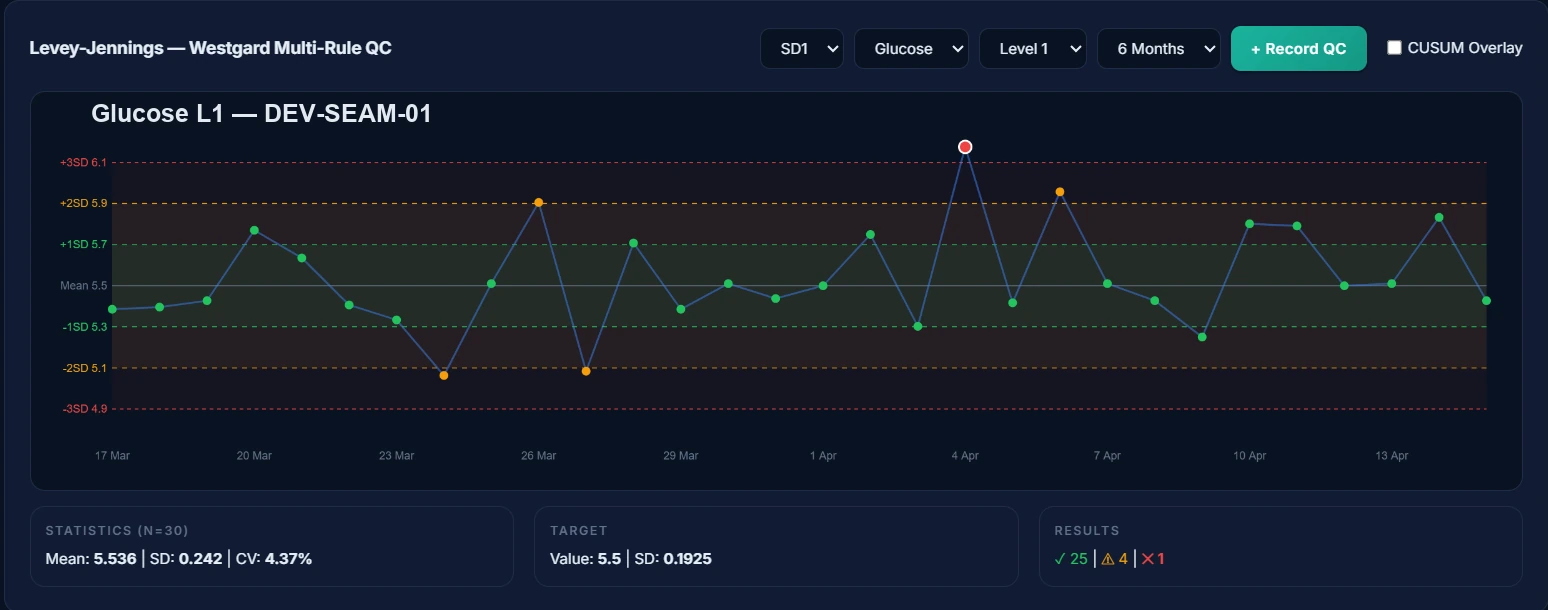
Every control run plotted per analyser, level and test. The Westgard rules you choose (1‑3s, 2‑2s, R‑4s, 4‑1s, 10‑x and more) check each run as it lands and record which rule caught it. A monthly QC review is built for you to sign.
Quality control →A failed control can stop that test on that analyser until someone has reviewed it and a repeat passes. The right people are alerted. Staff whose certification has lapsed can be blocked from testing too.
A failed control or proficiency result can open a non-conformance automatically. Root cause, corrective action, owner and due date, and a check that the fix worked before it can close.
Quality management →Procedures versioned, approved and signed electronically. Staff read and sign each new version, you can see who has not, and review dates come round before they lapse. Old versions are kept, never overwritten.
The six CLIA competency elements recorded per person: direct observation, result monitoring, records review, maintenance checks, blind samples and problem solving. Assessment forms, uploaded evidence, a training matrix and reminders before anything expires.
Operators and competency →Enrolment, shipment deadlines and reminders, results and scores, and an investigation for every unacceptable result that can raise a corrective action. The annual summary is ready to print.
Proficiency testing and EQA →Verify a new analyser or reagent lot with the standard five-day precision study and a method comparison, using QC you already hold or typed replicates, then sign the verification pack.
Statistics Workbench →For tests that use an IQCP: a risk assessment across specimen, environment, reagent, test system and operator, the plan itself, approval and revision, and ongoing checks against your live QC so you know the plan still holds.
Readiness checklists for CLIA, CAP and Joint Commission, and ISO 15189 for UK and international labs, scored live from your records: daily QC, proficiency testing, competency, method verification, calibration, corrective action, records and procedures.
Every change records who made it, when and why. The log is tamper-evident and can be checked end to end, and any record's history can be exported for an inspector.
Audit trail →Lot numbers and expiry for reagents and controls, which results ran on which lot, recall impact, and maintenance, cleaning and temperature logs per analyser.
Lot traceability →QC, lockout, operator certification and the audit trail are part of the core platform. Quality management, document control, proficiency testing, IQCP, the competency suite and method validation are add-ons switched on per site.
How it connects
Connectivity, QC and compliance are one workflow in Catenix, not three products glued together.
Patient results and QC runs arrive automatically from connected analysers. QC is kept apart from patient records, and nobody types a number twice.
Each control run is checked against your Westgard rules the moment it arrives. A failure can hold that test until someone looks.
The review, the corrective action and the repeat run are recorded in the name of the person who did them, linked to the run that started it.
QC log, monthly sign-off, corrective action and audit trail are already filed together. Inspection prep becomes a check, not a project.
The proof
| Inspector asks for | Where it is in Catenix |
|---|---|
| QC on each day of testing, and what you did when it failed | Control runs captured from the analyser, the rule that fired, the review and the repeat, signed monthly |
| Corrective action records | Non-conformances and corrective actions linked to the failed run or proficiency result |
| Current, approved procedures | Controlled documents with versions, approvals and staff sign-off |
| Staff competency | Six-element competency per person, with evidence, expiry dates and reminders |
| Proficiency testing | Deadlines, results, investigations and the annual summary |
| Method verification | Signed verification packs for new analysers and reagent lots |
| Who changed what, and when | A tamper-evident audit trail with per-record history and exports |
A clear boundary
Compliance here means keeping your records, your rules and your sign-offs: workflow and record-keeping. Catenix is connectivity, workflow, record-keeping and data display. It does not interpret results, calculate clinical values, classify or flag results clinically, or provide clinical decision support. Readiness checklists help you prepare; inspection and accreditation decisions stay with the inspecting body.
Questions, answered
For the testing you run on site, Catenix keeps the records an inspector asks for: QC, corrective actions, procedures, staff competency, proficiency testing, method verification, readiness checklists and the audit trail. Because it is the same system that receives your analyser results, nothing has to be copied across. If you also run a wider quality system for other parts of the business, Catenix sits alongside it.
CLIA, CAP and Joint Commission for US laboratories, and ISO 15189 and CQC for UK and international services. Each checklist is scored from your live records, and the items that need a person's judgement are answered by your team. The checklists help you prepare; the inspection and any accreditation decision stay with the inspecting body.
The run is flagged with the Westgard rule that caught it. If lockout is switched on for that analyser and test, testing is held until someone reviews the failure and a repeat passes. The review can open a non-conformance and corrective action in one step, and the whole thread appears in the monthly QC review ready to sign.
Yes. QC and other records can be entered by hand. Connecting analysers is what makes the records build themselves, so most clinics connect them during setup.
QC with Westgard rules, QC lockout, operator certification and the audit trail are part of the core platform. Quality management (non-conformances, corrective actions, audits), document control, proficiency testing, IQCP, the competency suite and method validation are add-ons switched on per site, so you pay only for what you use.
We will show how each finding would have been recorded, tracked and evidenced in Catenix, on a live system.