Chained, not just logged
Each row's hash includes the previous row. Alter or delete one and the chain breaks at that point. Verification is paged, per organisation, and its last outcome is shown on an integrity banner.

Core platform
An audit trail is only worth having if it cannot be quietly edited and if the record you need can be found in seconds. Catenix hash-chains every row, verifies the chain on demand, and opens the history of any result, patient, device or QC run from wherever you are looking at it.
What it does
Each row's hash includes the previous row. Alter or delete one and the chain breaks at that point. Verification is paged, per organisation, and its last outcome is shown on an integrity banner.
Reviews, voids, matches, sign-offs, configuration changes and rule edits are attributed to the authenticated user. Nothing is attributed from what a browser sent.
A drawer listing everything that happened to a result, patient, device or QC run, opened from the record itself.
PDF or CSV extracts state the filter, the range and the row cap on a cover page, so the extract is evidence of itself.
Electronic signatures carry a meaning statement and a signature hash on the signed record.
Bulk exports of patient data and the AI assistant's read-only database queries each leave an audit row.
QC evaluations can carry receipts that an outside party can verify independently.
How it works →Encrypted in transit and at rest, role-based access, regional data residency and Cyber Essentials certification.
Security →In one picture
A hash chain is a simple idea with a useful property: you cannot change history without leaving a mark. Verification reads the chain from the start and stops at the first row that does not match.
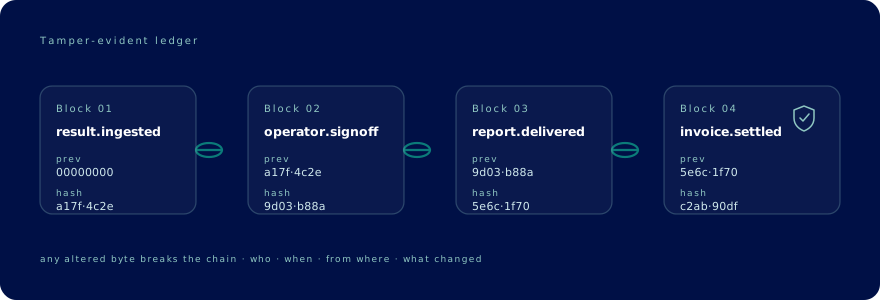
A clear boundary
Catenix is connectivity, workflow, record-keeping and data display. It does not interpret results, calculate clinical values, classify or flag results clinically, or provide clinical decision support. Statistics describe methods, processes and datasets, never a patient. Any reference range or note shown is customer-authored content Catenix displays.
Questions, answered
Every state-changing action: who, when, from where, what changed, with before-and-after values where it matters. That includes result matching and corrections, QC reviews and voids, device and analyte configuration changes, notification rules, sign-offs, exports of patient data and the AI assistant's database queries.
Each audit row carries a hash that includes the previous row, so a deleted or altered row breaks the chain. Verification walks the chain for your organisation, records the last verification, and the audit screen shows an integrity banner with the outcome.
Yes. Any result, patient, device or QC run has a history drawer listing everything that ever happened to it, opened from wherever the record is shown.
Extracts to PDF (up to 2,000 rows) or CSV (up to 10,000 rows) with a cover sheet stating the filter, the range and the cap, so what was extracted is itself evidenced. Larger exports belong to scheduled reports.
When someone signs a review, the trail records who, when, what was signed and a plain statement of what the signature meant, for example "I have reviewed this QC run and accept it". It is the pattern 21 CFR Part 11 describes.
We will open the history of a result, run verification on a live tenant and print an extract with its cover sheet.