Captured, not typed
The gateway recognises control runs and files them against your QC records, never a patient's chart. Nobody re-keys a control value.

Home / Platform / Quality control
Core platform
Controls captured straight from the analyser, Westgard rules that fire when they should, lockouts that hold a device until someone has looked, and the monthly review already written. Catenix keeps QC evidence as a by-product of running the bench.
On the chart
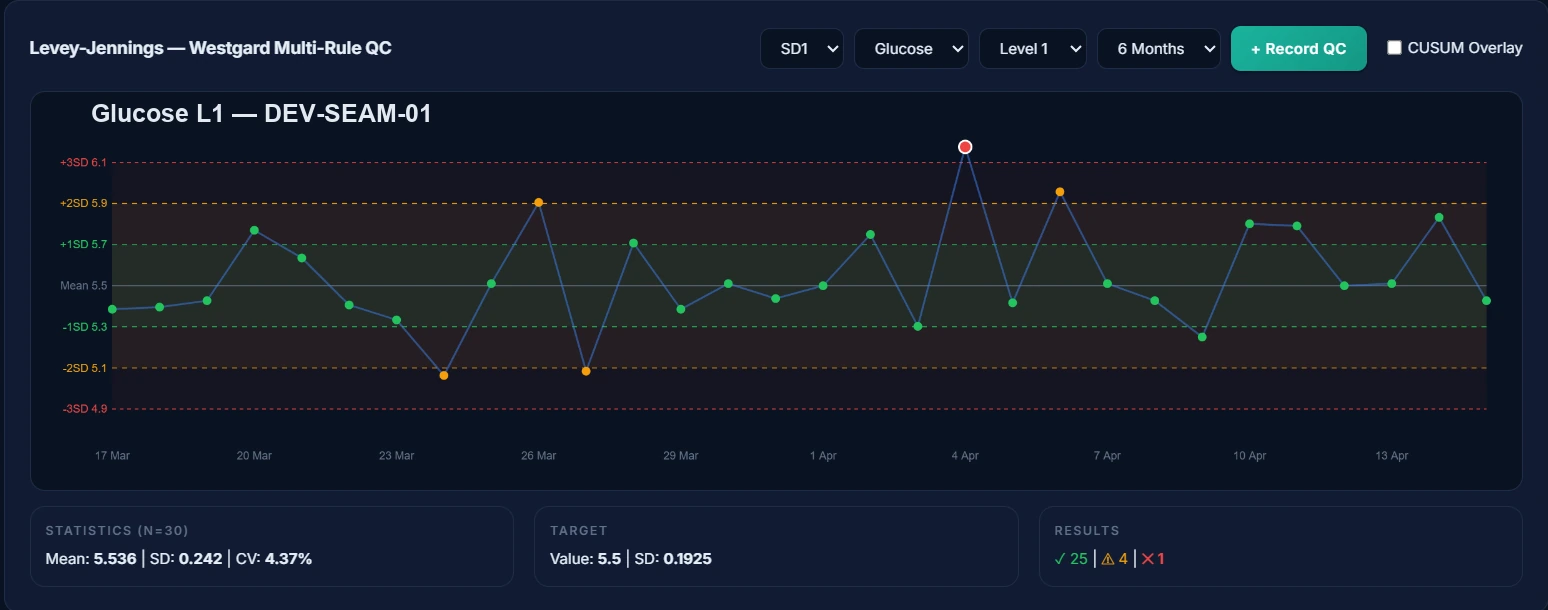
Every control run plots itself against the mean and standard deviation for that device, level and analyte. When a rule fires, the run is flagged with the rule that caught it and the lockout engine can hold the device until the failure has been reviewed.
What runs in the background
The gateway recognises control runs and files them against your QC records, never a patient's chart. Nobody re-keys a control value.
Westgard multi-rule evaluation per device, level and analyte, with the rule recorded on the run. Reviews, voids and bulk accepts are attributed to the signed-in user; a void needs a real reason.
A failed control can hold the device. Testing resumes when the failure has been reviewed and the repeat has passed.
QC schedules per device show what is due, what is overdue and where. An overdue row lets you record the run with device, analyte and level already filled in.
Opened date, open stability and storage location on every material. Expiring controls surface 14 days ahead; an expired one blocks manual QC unless an audited override reason is given.
Every rejected run needs a cause, an action and a repeat. If it warrants it, the review raises a non-conformance in Quality Management with one click, and rejections can auto-open one as a major NC.
A monthly summary per analyser and ward (runs, rules fired, failures, reviews) is signed by the person who reviewed it, which is the evidence ISO 15189:2022 clause 7.3.7.2 expects. A missing signature for last month shows in the Action Centre.
The lot-change wizard evaluates the new control lot against the old one using the CLSI EP26 approach and records the decision.
An individualised quality control plan tab for tests that use one, alongside the routine QC record.
A failure, end to end
Nothing here is a separate form. The review is attached to the run, the NC is attached to the review, and the month is attached to the person who signed it.
The control value arrives from the analyser, is plotted, and a Westgard rule fires. The run is marked rejected with the rule that caught it.
If lockout is configured for that device and analyte, patient testing on it is held until the review is complete.
The reviewer records the root cause, the action and the repeat run, in their own name. The review can raise a non-conformance in Quality Management.
Repeat passes, lockout lifts, the failure review and any NC are linked from the run, and the whole thread appears in the monthly summary ready for sign-off.
Going further
The Statistics Workbench takes CV from your IQC, bias from EQA and total allowable error from your specification or the built-in library to give sigma per analyte, the method-decision chart and Westgard Sigma Rules, so rule selection is based on how the method actually performs.
Statistics Workbench →Every QC evaluation can carry a receipt an outside party can check independently, so "the QC was fine" is a demonstrable statement rather than an assertion.
How provable QC works →IQC review checklists, ISO 15189:2022 audit templates and a management-review pack that pulls IQC data automatically.
Quality management →A clear boundary
Quality control here means tracking controls and the clinic's own Westgard rules: statistics and workflow. Catenix is connectivity, workflow, record-keeping and data display. It does not interpret results, calculate clinical values, classify or flag results clinically, or provide clinical decision support. Any reference range or note shown is clinic-authored content Catenix displays.
Questions, answered
Westgard multi-rule evaluation on Levey-Jennings charts, configured per device, level and analyte, feeding a lockout engine that can hold testing on a device until a failed control is resolved. Rule selection can be informed by sigma metrics from the Statistics Workbench.
No. Catenix tracks control statistics and the rules you set. Clinical interpretation stays with the qualified professional and the analyser's instructions for use.
The run is flagged, the rule that fired is recorded, and the failure needs a review: root cause, action taken and the repeat. A review can raise a non-conformance in Quality Management in one step. Reviews and voids are attributed to the signed-in user and a void needs a real reason.
Yes. Controls carry opened date, open stability and storage location. An expired material blocks manual QC unless an override reason is given, and the override is audited. Expiring materials show up 14 days ahead.
Catenix builds a monthly summary per analyser and ward (runs, rules fired, failures, reviews) and records the sign-off against the person who signed it. A missing sign-off for last month is an Action Centre signal.
We will show QC capture, a rule firing, the lockout, the failure review and the monthly sign-off working together on a live tenant.