Home / Resources / Point-of-care testing software

Buying guides · Plain-English guide

Point-of-care testing software: a buyer's guide

What POCT software actually does, the problems it solves, what to look for, and the questions worth asking a vendor before you sign.

Published 1 July 2026 · Last reviewed: July 2026 · 7 min read

Point-of-care testing software takes the results your analysers already produce and turns them into records you can actually use. It captures each result electronically the moment a device finishes, attaches it to the right patient and the operator who ran it, manages your quality control, and carries the finished record through to a report, an export or an invoice. No printouts, no re-typing, no gaps.

If you run point-of-care tests today without software, you already know the routine. The result sits on a device screen or a slip of thermal paper. Someone copies it into a spreadsheet or a document. QC lives in a folder. When a patient or an inspector asks for the record, someone goes hunting. This guide covers what the software category does, what separates a good platform from a brochure, and how Catenix answers each question a buyer should ask.

The problems POCT software solves

Four problems come up in almost every clinic and testing service we speak to, whatever the specialty:

  • Results stuck on devices. The analyser measured it, but the number never left the machine. It gets read off the screen, photographed, or printed and filed. Every one of those steps can lose or change the value.
  • Re-typing into spreadsheets. A staff member copies results from the device into Excel or a Word template, then again into a report, then again into the invoice. Each copy is a chance for a transposed digit, and it eats hours every week.
  • Paper QC logs. Control results recorded by hand, charts drawn in Excel if at all, and no reliable way to show that a device was in control on the day a result was produced.
  • No audit trail. When someone asks who ran a test, on which device, with which lot, and who reviewed it, the honest answer is often "we would have to work that out". Accreditation bodies and clinical governance both expect a better answer.

POCT software exists to remove each of these. The result travels electronically from the device into one system, and everything that happens to it afterwards is recorded.

See it working

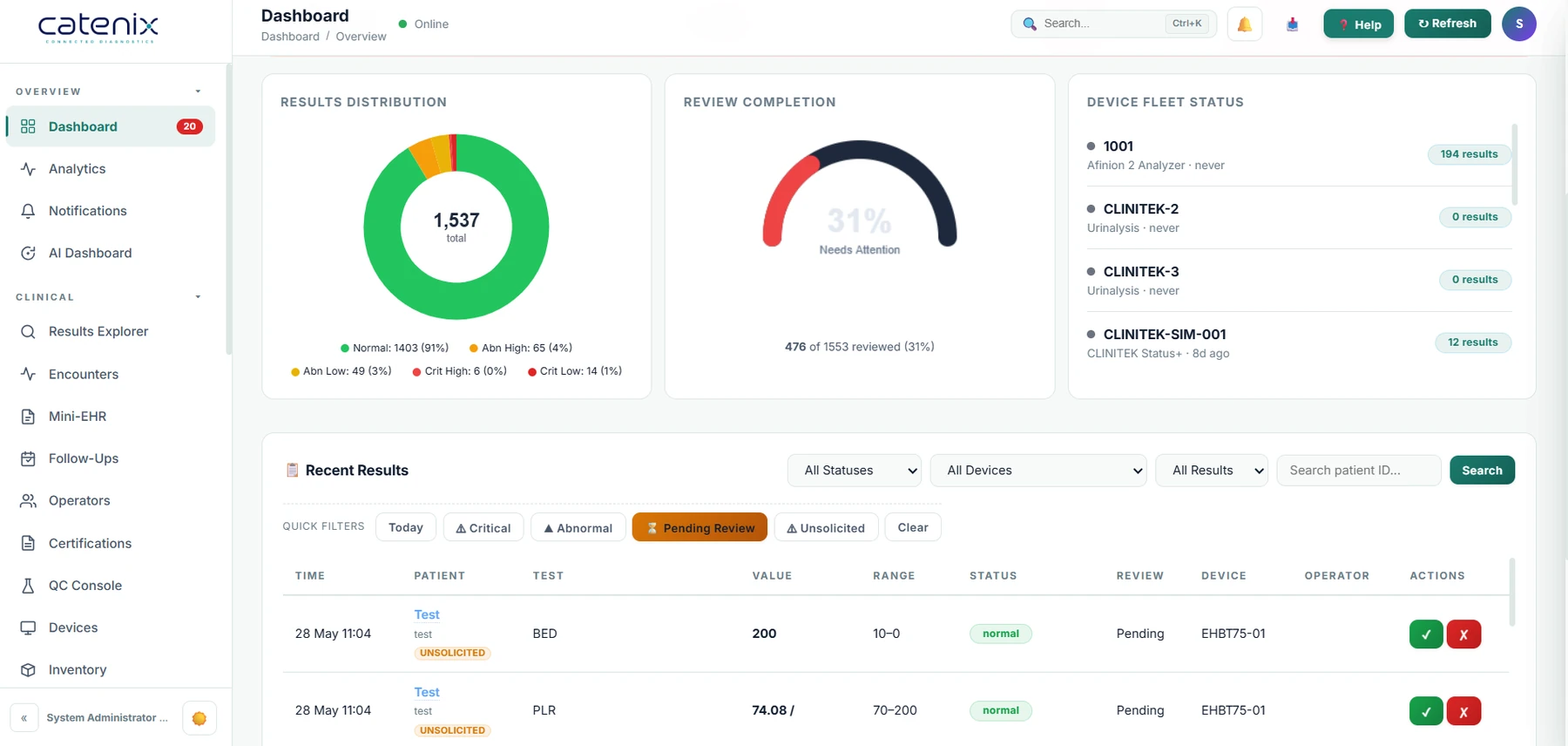
One dashboard for the whole bench.

portal.catenix.com
Catenix operational dashboard showing results distribution, review completion, device fleet status and recent results

What to look for

What good POCT software includes.

The category ranges from single-vendor data managers to full clinic platforms. Whichever end you buy at, six capabilities decide whether the software earns its keep.

Device connectivity

Speaks to the analysers you actually own, across vendors, using HL7 v2, POCT1-A2, ASTM E1394 and vendor-specific formats. If the devices do not connect, nothing else matters; see which analysers Catenix connects and the connectivity layer.

QC management

Controls captured automatically, charted on Levey-Jennings plots and evaluated against Westgard rules, with operator lockout where policy requires it. Statistical process control on control material, not interpretation of any patient result; see the quality module and our QC software guide.

Audit trail

Every result traceable to the operator, device, time and, where relevant, reagent lot, with the original device message retained. The record is a query away, not a filing cabinet away.

Reporting

Clean, branded reports generated from the captured data, delivered to the patient or the referrer without a re-typing step; see reporting.

Billing

In private settings the test is also a sale. Packages, invoices and card payment close the loop; see billing.

Before you sign

Questions to ask a vendor, and how Catenix answers them.

Brochures converge; working software does not. These questions separate the two.

01
"Can you show my analysers connected, live?"
Ask for a demonstration with your device list, not a compatibility table; Catenix demos against your actual analyser models, and drivers for supported devices are part of the platform, not a paid extra.
02
"What happens when a result cannot be matched to a patient?"
There should be a defined queue and a resolution workflow, not silent failure; Catenix holds unmatched results for review with the full device message attached.
03
"Where does QC live?"
If the answer involves exporting to Excel, keep looking; Catenix charts controls, evaluates rules and records review inside the platform.
04
"Can I trace any result end to end?"
Ask them to pick a result and show its history, device, operator, time, QC state, report and every view and edit; Catenix keeps that chain for every record.
05
"How do you price it, and where is my data hosted?"
Per-test fees punish growth, so Catenix is a subscription per clinic or site with no per-test charges; ask about region, residency and encryption, and read the security documentation before the sales call, not after.
06
"Does the software make clinical calls?"
It should not; Catenix does not interpret clinical results and provides no clinical decision support, so clinical judgement stays with your team.

Where to start

Write down three things before you talk to any vendor: your device list, your weekly test volume, and the moment in your current workflow that hurts most. Most buyers find the pain is not the testing itself but everything around it: the typing, the chasing, the folder of QC paper. If you want the deeper technical background first, start with what POCT middleware is and the standards guide. If you run a private clinic, our private-clinic guide follows the whole day from booking to invoice.

← Back to resources

Questions, answered

The questions buyers ask first.

What is point-of-care testing software?

Point-of-care testing software captures results electronically from POCT analysers, attaches them to the right patient and operator, manages quality control, and turns the finished record into reports, exports and invoices. It replaces printouts, re-typing and paper QC logs with one traceable electronic record.

Do I need POCT software if I only run a few devices?

Even two or three analysers generate results that must be recorded, checked against QC and reported to someone. Done by hand, that means re-typing, transcription errors and no audit trail. POCT software removes the manual step and keeps a record of who ran what, on which device, and when, from the first device onwards.

How does POCT software connect to my analysers?

Through each device's own interface, serial, network or docking station, using standards such as HL7 v2, POCT1-A2 and ASTM E1394 plus vendor-specific formats. Typically a small gateway on the clinic network listens to the devices and forwards results securely to the platform.

Does POCT software interpret results?

No. Good POCT software manages the data workflow: capture, matching, quality control, reporting and audit. Catenix does not interpret clinical results and provides no clinical decision support. Interpretation stays with the clinician and the analyser's instructions for use.

See Catenix on your bench.

Bring your analyser list. We'll show results landing in the record, live.