Automatic capture
Control results should never be transcribed. Catenix recognises QC runs as QC across vendors and message formats, so each control lands in the QC record by itself, tagged with device, operator, control material, lot and level.

Home / Resources / QC software for point-of-care devices
Quality · Plain-English guide
Controls captured automatically, charted and evaluated as they land, with records an inspector can read. No paper log, no Excel chart.
Published 1 July 2026 · Last reviewed: July 2026 · 6 min read
In most clinics that run point-of-care tests, QC lives on paper or in Excel. Controls get run, the values get written in a log or typed into a spreadsheet, and a chart gets drawn when someone has time. Nothing stops a device being used after a failed control except memory. Then an inspection is announced, and the week before it disappears into hunting for logs, filling gaps and hoping the story holds together.
QC software replaces that with a live record. Control results come off the analyser electronically, land on a chart within seconds, are evaluated against your rules automatically, and every review is signed and stored. This page covers what a proper QC system for POCT includes and how Catenix implements each piece.
See it working
The QC system
Control results should never be transcribed. Catenix recognises QC runs as QC across vendors and message formats, so each control lands in the QC record by itself, tagged with device, operator, control material, lot and level.
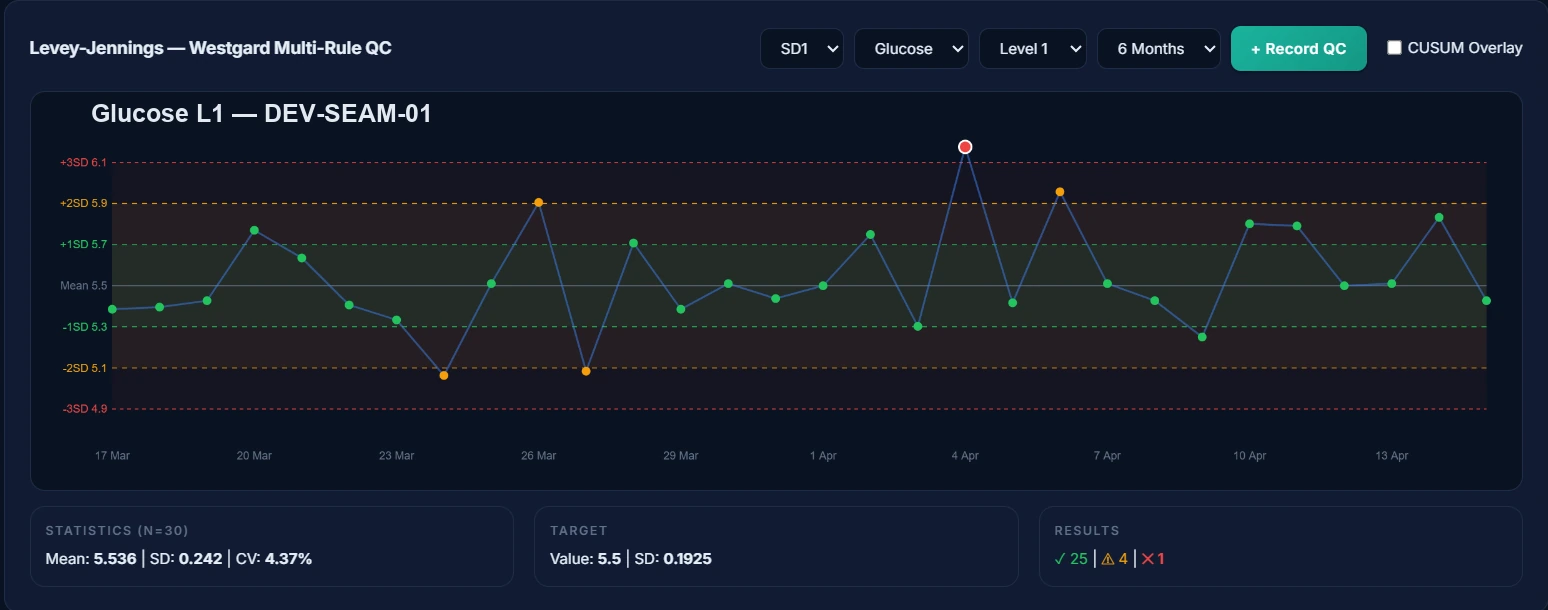
Each analyte and level charted against the target mean with bands at 1, 2 and 3 standard deviations, so drift and shifts show up as a picture rather than a column of numbers.
Multi-rule evaluation the moment each control lands, distinguishing random noise from a process that has genuinely moved, with violations flagged for review.
Where your policy requires it, Catenix can hold a device out of patient use until a failed control is resolved and the resolution documented.
Who is trained on which device, when their competency was last assessed, and when it lapses, kept current across sites by the administration layer.
Every control value, rule evaluation, review signature and lockout event stored and queryable, so assessment preparation becomes retrieval, not reconstruction.
One point worth stating plainly: QC evaluation is statistical process control applied to control material. It monitors whether the measuring process is behaving as expected. It is not interpretation of any patient result, which stays with the clinician and the analyser's instructions for use. Catenix does not interpret clinical results and provides no clinical decision support.
If you want the theory behind the charts and the multi-rule scheme, our guide to Levey-Jennings charts and Westgard rules walks through every rule with examples. On the accreditation side, ISO 15189 and its point-of-care annex expect documented QC procedures, recorded review, operator competency and traceability from every result back to a device in a known state; our guide to ISO 15189 for POCT maps the standard's clauses to the records you need. The honest caveat is that software supplies the evidence, while accreditation remains an organisational effort of procedures, people and review. The quality module shows how lockout, competency and the QC Console work together, on the same connectivity layer that carries patient results.
If you are evaluating platforms more broadly, the buyer's guide to point-of-care testing software puts QC alongside connectivity, reporting and billing, with the vendor questions to ask for each.
Questions, answered
It captures control results automatically from your analysers, plots them on Levey-Jennings charts, evaluates them against Westgard rules, records who reviewed each run, and can hold a device out of use until a failed control is resolved. The output is a complete, inspection-ready QC record with no manual logging.
Yes, if the platform is vendor-neutral. Catenix captures control results across vendors and normalises them, so every device's QC lives in one place with one review workflow, rather than one silo per manufacturer.
No. QC evaluation is statistical process control applied to control material: it monitors whether the measuring process is behaving as expected. Catenix does not interpret clinical results and provides no clinical decision support; patient results stay with the clinician and the analyser's instructions for use.
It addresses the record-keeping side. ISO 15189 and the POCT annex expect documented QC, review, operator competency and traceability. QC software produces those records as a by-product of daily work, so assessment preparation becomes retrieval rather than reconstruction. Accreditation itself remains an organisational effort.
Bring your analyser list. We'll show results landing in the record, live.