The device's interface
Find the host-interface or LIS section of the operator manual. Serial port, network socket, USB or docking station? Which protocol and version does it claim?

Home / Resources / Connect an analyser to your LIS or EHR
How-to · Connectivity
How to connect an analyser to your LIS or EHR: the three options, the standards involved, what to check before you start, and realistic timelines.
Published 1 July 2026 · Last reviewed: July 2026 · 6 min read
Every analyser can produce a result. The work is getting that result into your LIS or EHR with the right patient attached, without anyone re-typing it. This guide walks through the options, the standards you will meet along the way, the questions to answer before you start, and what a realistic timeline looks like.
Your three options
| Direct interface | Middleware | Manual entry | |
|---|---|---|---|
| Effort to set up | A point-to-point project per analyser and LIS pair | One platform; one integration to the record instead of one per device | None up front; the effort moves into every working day |
| Ongoing maintenance | Every LIS upgrade or device swap reopens the work | Device protocols handled by the platform on one side, a single consistent feed on the other | Constant re-typing, checking and chasing missing results |
| Traceability | Good, for the device that was interfaced | Full: each result tied to device and operator, original message retained | None between the device and the record |
| Best for | Hospitals with an interface team | Most clinics, and any bench running several devices | A stopgap while an interface is set up |
Manual entry is how most clinics start and the option every interfacing project is trying to retire. For most clinics middleware is the practical route; our plain-English middleware guide covers the category in depth.
HL7 v2 is the messaging standard most health systems use to exchange orders and results, usually framed as MLLP over a network connection. ASTM (E1394) is an older result-transfer standard many bench-top analysers still speak, originally over a serial cable. POCT1-A2 is the standard written specifically for point-of-care devices, carrying results, operator lists and QC between a device or docking station and a data manager. Many devices also speak a vendor-specific format that never made it into any standard. The full detail, segment by segment, is in our guide to HL7, POCT1-A2 and ASTM.
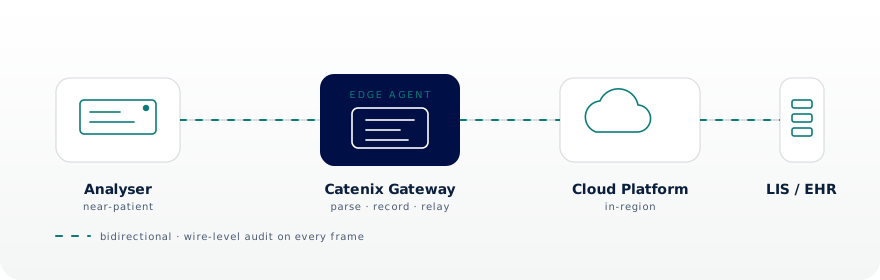
Analysers live on clinic benches, not on the internet. An edge gateway is a small piece of software on a computer inside the clinic that bridges the gap: it listens to the devices locally, over a serial cable or the clinic network, and forwards each result securely to the platform. A good gateway also does three quietly important things:
Honest ranges, assuming people answer their email: connecting an analyser to middleware that already has a driver for it is typically hours to a few days, most of which is verification. A device that needs a new driver adds days to a few weeks depending on documentation quality. A direct point-to-point interface built from scratch is usually weeks to months, because message mapping, testing and change control all sit inside your project. Whatever route you take, budget real time for verification: parallel-running the interface against the device display or printout until you trust it.
Before you start
Find the host-interface or LIS section of the operator manual. Serial port, network socket, USB or docking station? Which protocol and version does it claim?
Many analysers ship with the host interface switched off. Check for host communication, baud rate or destination IP, and whether a vendor engineer needs to enable it.
Is there a wired or wireless network where the devices sit? Can a PC on that network make an outbound HTTPS connection? Fixed IPs or reserved DHCP for devices help.
What can it accept: HL7 v2 results, a file import, an API? Who controls that interface, and what is their change process and lead time? The item most projects underestimate.
Agree how patients, operators and devices will be identified in messages before the first test message is sent, not after.
How Catenix does it
Drivers for supported analysers are part of the platform, not a separate project. See the connectivity layer in detail and which analysers Catenix connects. Catenix moves and records results; it does not interpret clinical results and provides no clinical decision support.
Questions, answered
Three options: a direct point-to-point interface built between the analyser and the LIS, middleware that sits between them and translates, or manual entry as a stopgap. For most clinics middleware is the practical route, because one platform handles every device's protocol and presents the LIS or EHR with a single, consistent feed.
Check the device's operator or host-interface manual. Bench-top analysers usually speak HL7 v2 or ASTM over a serial port or network socket; purpose-built point-of-care devices often speak POCT1-A2 through a docking station. Some devices only offer a vendor-specific format, which is a job for middleware rather than a direct interface.
An edge gateway is a small piece of software on a computer inside the clinic that talks to the analysers locally, over serial or the clinic network, and forwards results securely to the platform. You need one whenever devices cannot reach the internet themselves, which is nearly always, and it also buffers results locally so nothing is lost when the connection drops.
With middleware that already has a driver for the device, connection is typically hours to a few days including verification. A direct point-to-point interface built from scratch is usually measured in weeks to months, because the message mapping, testing and change control all fall on your project.
Bring your device list. We'll show results landing in the record, live.